


3. Above-the-Fold Intro
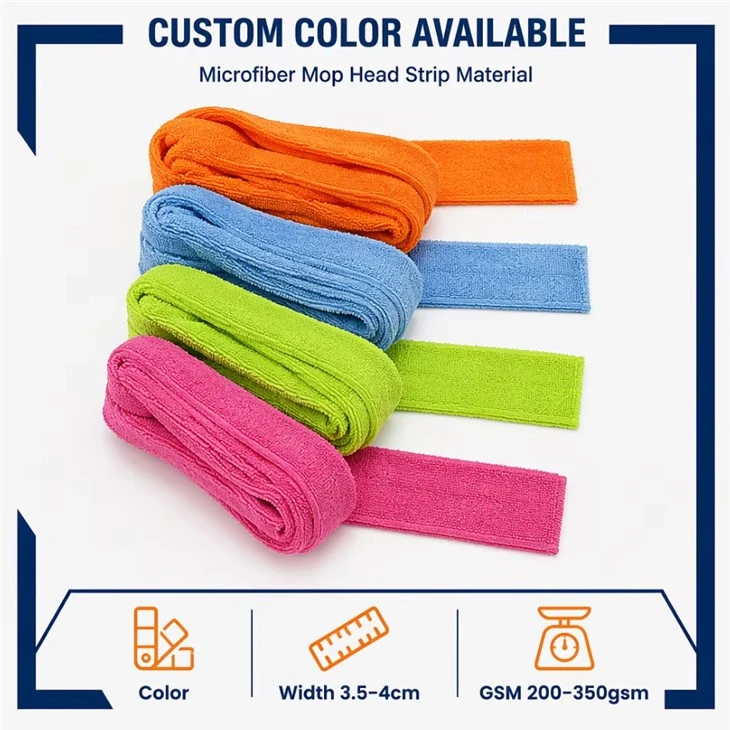
Microfiber mop strips are the cut cloth material that mop factories and cleaning-product brands build flat mop heads, strip mop heads and dust mop refills from. We produce these strips in two material lines - 100% polyester and an 80% polyester / 20% nylon (polyamide) blend - in the two widths mop assembly lines run most often, 3.5cm and 4.0cm, and in any gram weight between 200GSM and 400GSM.
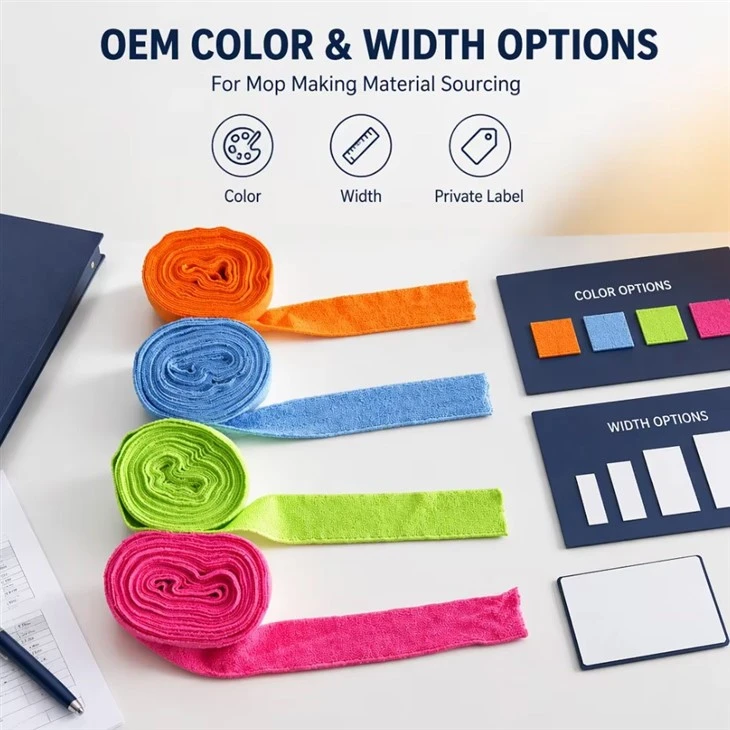
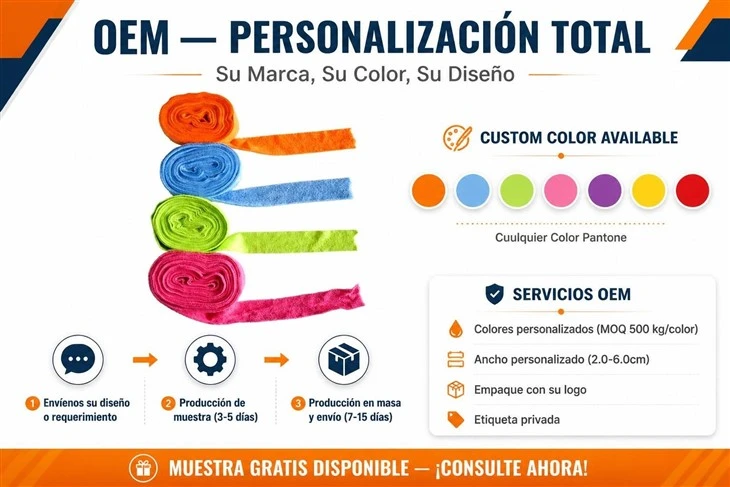
Because the strips are supplied as continuous rolls rather than pre-cut pieces, your cutting, folding, sewing and binding stations can be set to your own strip length instead of being locked to a fixed size. Colors are dyed to your color card or to your buyer's brand palette, and OEM logo printing is available. Free samples of stock colors are available for hands-on testing before you commit to a production order.
4. Key Features
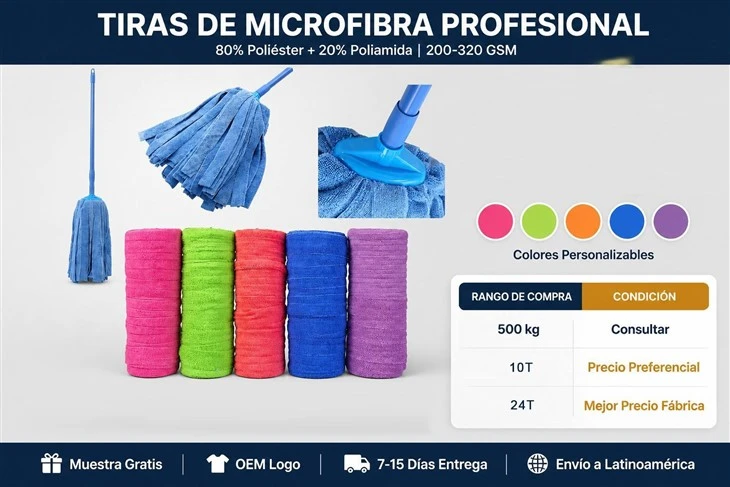
Two material options on one production line - 100% polyester for cost-controlled standard wet mop lines, and 80% polyester / 20% nylon for buyers who need faster water pickup.
Widths built for mop assembly - 3.5cm and 4.0cm are held as standard, so strip mop, flat mop and dust mop head lines feed material straight into cutting and sewing stations.
Gram weight matched to your spec - 200GSM to 400GSM are all available; 250GSM, 280GSM and 300GSM are the weights mop makers order most.
Custom dye lots and color coding - strip colors can be matched to your color card or to a color-coded cleaning system, so one production run covers several SKUs.
Low lint shedding - the microfiber construction is built to resist fraying once the roll is cut into strips, keeping fibers off the surfaces your buyer's mop is cleaning.
Continuous roll supply - supplied in roll form so you set the cut length; no fixed-length constraint from the mill.
OEM logo support - logo printing available for brands that sell the strips under their own label.
Free sample before bulk - stock color samples are supplied free so your technical team can test absorbency, weight and hand-feel first.
5. Specifications
| Specification | Detail |
|---|---|
| Product name | Microfiber mop strips / mop head strips |
| Material options | 100% Polyester; 80% Polyester 20% Nylon (Polyamide) |
| Standard widths | 3.5cm and 4.0cm |
| Gram weight range | 200GSM – 400GSM |
| Most ordered weights | 250GSM, 280GSM, 300GSM |
| Form of supply | Continuous roll, cut to your required strip length |
| Color | Custom - dyed to your color card or brand palette |
| Primary application | Mop head production (flat mop, strip mop, dust mop) |
| Customization | Custom color, OEM logo printing |
| Sample | Free sample in stock colors |
6. How the Material Choice Changes Mop Performance
80% Polyester / 20% Nylon vs 100% Polyester. Polyamide is more hydrophilic than polyester, which is why adding nylon to the blend gives a strip that wets out faster and releases water more completely when the mop is wrung. Pure polyester strips are stiffer, more abrasion-resistant and cost less per kilo, which suits entry and mid-tier wet mop lines where scrubbing durability matters more than maximum water pickup. Choose the blend when your buyer's complaint list includes "the mop stays half dry" - choose 100% polyester when the priority is price per unit and mechanical wear.
Why gram weight is the specification that decides service life. A 200GSM strip is light and dries quickly, which fits dust mops and light kitchen use. At 250–280GSM the strip holds noticeably more water per pass, which is the range most hotel and facility-management buyers land on. At 300GSM and above the strip resists matting under repeated wringing, and that is where commercial and industrial floor-cleaning programs sit. Because we produce the full 200–400GSM band on the same line, you can hold one supplier across your entire mop range instead of splitting low-weight and high-weight buying between two mills.
Why the strips shed less lint once cut. The fabric is cut into narrow strips, and cut edges are where microfiber normally starts to run. A denser, more tightly bonded construction keeps the cut edge stable through cutting, folding, sewing and binding, so fewer loose fibers end up on the floor your buyer's mop is cleaning - the single most common quality complaint in mop head production.
Care guidance for the finished mop. Advise your end users to skip fabric softener: softener coats the fiber surface and blocks the capillary action that makes microfiber absorb water in the first place, so a softened mop behaves like an ordinary cloth. Wash colored strips separately from lint-shedding textiles and avoid chlorine bleach on dyed lots so the color coding stays readable across the mop's service life.
7. Where These Strips Are Used
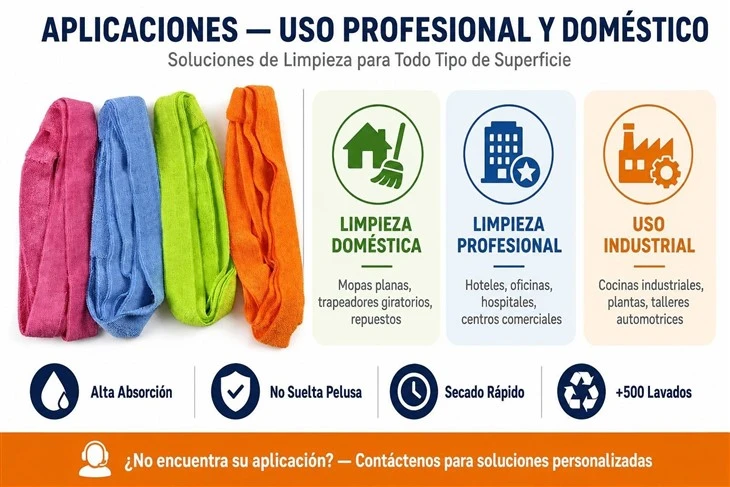
Mop head manufacturing - flat mop heads, strip mop heads, dust mop heads and replacement refills built from cut cloth.
Housekeeping and hotel floor care - 280–300GSM weights for guest-room and corridor wet mopping.
Commercial and industrial floor cleaning - strips for industrial cleaning carts and heavy-duty wet mops.
Retail and supermarket floor care - high-traffic entrance and aisle cleaning where water pickup per pass drives labor cost.
Color-coded cleaning programs - one dye lot per zone color for kitchens, restrooms, front-of-house and back-of-house so cleaning teams cannot cross-contaminate between areas.
Foodservice and food-processing environments - zone color systems that keep cleaning tools visually separated by area.
Healthcare and institutional cleaning - color separation between patient areas and general areas.
Private-label and OEM mop brands - strips supplied under your own brand with your logo.
8. Customization and OEM
Color matching - send your color card, Pantone reference or brand palette and we dye the lot to match, so several mop SKUs can run from one order.
Width - 3.5cm and 4.0cm are held as standard; other widths can be discussed against your cutting specification.
Gram weight - any weight between 200GSM and 400GSM, including 250GSM, 280GSM and 300GSM.
Material ratio - 100% polyester, or 80% polyester / 20% nylon.
OEM logo - logo printing available for brands selling the strips under their own label.
Specification confirmed before production - the agreed width, gram weight, material ratio and color reference for each lot are locked in writing before the line starts, so the delivered roll matches the sample your technical team approved.
9. Ordering, MOQ and Packing
MOQ. Standard minimum order is 3,000 kg per color and material combination. Smaller trial quantities can be discussed for a first order so you can validate the strip on your own line before committing to volume.
Volume pricing. Tiered pricing applies at 10 t and 24 t order levels. Send your target quantity, width, gram weight, material ratio and color reference and we will quote against the correct tier.
Free sample. Stock-color samples are supplied free for absorbency, weight and hand-feel testing. For a custom dye lot, a color lab dip is prepared against your reference first.
Packing. Strips are supplied wound in roll form. Roll put-up and carton specification are confirmed against your order before shipment.
Production timing. Lead time is confirmed at order confirmation and depends mainly on whether the color is a stock shade or a custom dye lot - stock shades move through the line faster than custom color. Confirm your target ship date with your quotation so the dye schedule can be planned around it.
10. FAQ
What width and gram weight should I choose for a flat mop head? For flat and strip mop heads, 3.5cm or 4.0cm width is the usual starting point. On weight: 200–250GSM suits light dust mops and kitchen use, 280–300GSM fits hotel and facility-management wet mopping, and 300GSM and above is for commercial and industrial floor-cleaning programs. Tell us the end use and we will recommend the weight band.
Is 80% polyester / 20% nylon better than 100% polyester? They solve different problems. The nylon blend wets out faster and releases water more completely when wrung, so it performs better where water pickup per pass is the buying criterion. 100% polyester is stiffer, more abrasion-resistant and lower in cost per kilo, which suits lines where scrubbing durability and unit price matter more. Many buyers run both.
Can the strips be dyed to our brand color? Yes. Send your color card, Pantone reference or brand palette. Color is matched on a lab dip before bulk dyeing, and one order can cover several colors so a color-coded cleaning range can be built from a single production run.
Are the strips supplied pre-cut or in rolls? They are supplied as continuous rolls, so your cutting, folding, sewing and binding stations set the strip length rather than being locked to a fixed mill length.
What is the MOQ, and can I get a sample? Standard MOQ is 3,000 kg per color and material combination, with tiered pricing at 10 t and 24 t. Free samples in stock colors are available; trial quantities can be discussed for a first order.
How should the finished mop be cared for? Avoid fabric softener - it coats the fiber and blocks the capillary absorption that makes microfiber work, so the mop stops picking up water properly. Wash colored strips separately from lint-shedding textiles and keep chlorine bleach away from dyed lots so color coding stays readable.
What are microfiber mop strips used for? They are the cut cloth material used to build flat mop heads, strip mop heads, dust mop heads and replacement refills. Buyers include mop factories, cleaning-product brands, private-label programs and facility-supply wholesalers.
Do you support OEM logo printing? Yes. Logo printing is available for brands selling the strips under their own label, alongside custom color and custom gram weight.
Hot Tags: 80% polyester 20% polyamide microfiber mop head strips 250gsm 280gsm 300gsm custom color terry fabric for mop making, China, manufacturers, suppliers, factory, price, Microfiber Braided String, Microfiber Cotton Twisted Yarn, Microfiber Mop Thread


