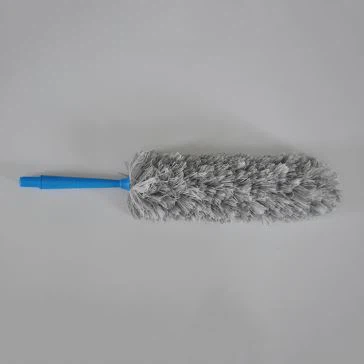



- Head
- Soft microfiber filaments, flat barrel shape
- Handle
- Short fixed handle - not telescopic
- Best for
- Car dashboards, air vents, narrow gaps, keyboards, blinds, furniture
- Use
- Dry dusting; slightly damp for sticky film
- Care
- Washable and reusable
Why a microfiber duster beats a cloth or a feather duster
It holds the dust instead of moving it. Microfiber filaments are fine enough to generate and carry a static charge, so dust clings to the fibres. A cotton cloth or a feather duster mostly relocates dust into the air, where it settles again an hour later.
The dust goes between the filaments, not on the surface. This is why a microfiber head keeps working for a whole dashboard instead of smearing after the first pass.
A short handle reaches what a cloth cannot. Vent slats, dash seams, keyboard gaps, blind slats and the gap between a cabinet and a wall are all handled by the slim head rather than by fingers.
No chemicals needed. For everyday indoor dust this is a dry tool - no spray, no wipes, nothing to buy again every month.
Washable and reusable. Rinse or wash it, let it dry, and it goes back to work. No disposables.
What it is made of
The head is a soft microfiber fabric - ultra-fine synthetic filaments, split finer than a human hair - shaped into a slim barrel and set on a short handle.
Two things make it work, and both are about the fibre, not the shape:
Fine filaments create a static charge. As the head moves, the filaments pick up and hold a charge, which attracts dust to the fibre.
The filament structure traps what it catches. Dust sits between the filaments rather than on top of them, so the head does not need to be shaken out every few strokes.
Because of that structure, a microfiber head has one hard rule: it must never be washed with fabric softener. Softener coats the filaments and destroys the very pickup you bought the duster for.
Dry or damp? Use it the right way
| Task | How to use it |
|---|---|
| Dashboards, consoles, keyboards, TV and monitor screens, lampshades | Dry. A dry microfiber head is what lifts dust; adding water to a dusty surface turns dust into streaks. |
| Vent slats, blind slats, dusty plastic trim with a sticky film | Slightly damp. Dampen the head, wring it out fully, then wipe. Never use it dripping. |
| Spilled liquid, grease, thick mud | Not this tool. A microfiber duster lifts dry dust. For grease use a degreaser and a cloth; for spills use an absorbent mop. |
The most common misuse is going in too wet. A microfiber head that is merely damp cleans better than one that is soaked, and it dries without leaving a film.
How to clean a car dashboard and air vents properly
This is the job this duster is shaped for, so it is worth doing in the right order:
Start at the top and work down. Roof lining edge, then dash top, then vents, then console and door panels. Dust falls, so the top goes first.
Push the head along each vent slat, not across it. Follow the slat lengthwise; the fibres ride in the groove and pull dust out of the corners.
Turn the head, do not drag back and forth. Short strokes plus rotation pick up more than fast scrubbing, which just flings dust into the cabin air.
Shake the head out outdoors once or twice during a full car interior. Do not shake it inside the car.
Finish with the screens using a dry section of the head. Screen dust is the most visible and the easiest to re-deposit.
Where it works, and where it does not
We would rather you buy the right tool once than the wrong tool twice:
| It does this well | It is not the right tool for |
|---|---|
| Car dashboard, vents, console, door panels, seat seams | Heavy grease or oil films |
| Keyboards, monitors, TVs, speaker grilles | Wet spills or standing water |
| Blind slats, window frames, shelf edges | Thick dried mud or builders' dust on rough surfaces |
| Lampshades, picture frames, skirting boards, tight corners | Sanitising - a duster removes dust, it does not disinfect |
If your main need is wet floor cleaning, this is not the product. If your main need is lifting dry dust from awkward, narrow surfaces, it is.
Care, washing and how long it lasts
Shake it out after each use. Most of what the head has collected comes off with a good shake.
Wash it warm with a little mild soap when the head looks grey or stops picking up dust.
Never use fabric softener, and never use a dryer sheet. Both coat the filaments and permanently reduce pickup.
Wash it separately from cotton towels and bedding. Cotton sheds lint that the microfiber head then collects, and the head turns into a lint magnet.
Air dry or tumble low. High heat can damage fine filaments.
Retire the head when the fibres stay flattened after washing and the pickup does not come back. Matting, not staining, is the wear point.
Extra tip: a head that has been used with a damp cloth on greasy surfaces may need warm water with a drop of dish soap before it will pick up dust properly again.
Wholesale and private label
| Item | Options |
|---|---|
| Head colour | [可定制颜色:可选色号] |
| Handle | [短柄颜色 / 长度 / 是否可加挂孔] |
| Handle length | [HANDLE-LENGTH] |
| Head size | [HEAD-SIZE] |
| Packaging | [YOUR PACKAGING OPTIONS] |
| Private label | [YOUR OEM / LABEL / BARCODE POLICY] |
| Logo | [是否支持印 logo 及工艺] |
| MOQ | [MOQ] |
| Sample lead time | [SAMPLE LEAD TIME] |
| Bulk lead time | [BULK LEAD TIME] |
Frequently asked questions
- What is a microfiber duster actually doing differently from a cloth?
- A microfiber head's fine filaments generate a static charge that attracts dust and then trap it between the fibres. A cotton cloth or feather duster mostly pushes dust into the air, where it settles back later.
- Is this duster telescopic?
- No. This is the short-handled version, built for close work such as dashboards, vents and furniture. We also make an extendable version for high ceilings and ceiling fans - see our extendable microfiber duster.
- Can I use it on screens?
- Yes, dry. Use a clean section of the head and light pressure. Do not use it damp on a screen.
- Can I use it wet?
- Only slightly damp, for sticky films on plastic trim and blind slats. Wring it out fully first. Never use it dripping, and never on electronics.
- How do I wash it?
- Warm water with a little mild soap, then air dry or tumble low. Never use fabric softener or dryer sheets, and wash it separately from cotton items.
- Why has my duster stopped picking up dust?
- Almost always fabric softener, or a head that is still damp. Softener coats the filaments and permanently reduces pickup; a damp head cannot generate the static that lifts dry dust.
- Will it scratch a dashboard or a screen?
- The filaments are soft, and the tool is used dry with light pressure. On gloss screens, use a clean section and avoid pressing hard, especially if there is grit on the surface.
- Does it work on keyboard gaps and blinds?
- Yes - narrow gaps and blind slats are exactly what the slim barrel head is shaped for.
Hot Tags: portable handheld microfiber duster with soft fluffy head for car dashboard air vent narrow gap keyboard and furniture, China, manufacturers, suppliers, factory, price, Duster, Duster Material In Roll, Hand Cleaning Car Brush, Microfiber Car Duster, Microfiber Duster, Microfiber Strip For Dusters